Today in the Flickr Favourites it's the turn of the traditional costume of the North-West Veluwe in The Netherlands. The North-West Veluwe is an area in the north-west of the province of Gelderland along the former Dutch Zuiderzee (but now it lies inland, because of land reclamation). If you have followed this traditional costume series on my blog, you will have noticed that all places and islands around and in the Zuiderzee had their own distinctive costumes. The original North-West Veluwe costume contains an ear ornament usually made of precious metal (locally called ‘oorijzer’, lit. ‘ear-iron’) and a colorful small cap with red flowers and lace. The female attire going with it, was mainly dark in color but with a red checkered scarf crossed over the kraplap (i.e. bodice). From the beginning of 20th century the old traditional costume was gradually replaced by the costume of the North-East of the Veluwe, because lots of the girls from the North-West Veluwe started working in the houses in the cities of the North-East Veluwe (like Kampen). The last woman who was wearing the old costume of the North-West Veluwe was Wijmpje Frens-Wouters, who died at the age of 102 in 2007.
For more flickr favourites see ArtMind's blog.

1. People of The Netherlands , about half a century ago - 'er zijn verschillende manieren om oud te worden , dit is er ook een van ...', 2. Eibertje, 3. Klederdracht, 4. Op en top Holland
And two picture postcards from my own collection.


This week I did not do much, did not sew a thing, but got a good idea for the EST winter swap. So, that's what I will do next week, working on the winter swap. Back to this week, I did some necessary administration and was happy about the fact that Etsy transformed my P8Accessories shop from dollars into euros. And I got my new business cards and postcards for my P8 Button Art shop on Etsy ! I think they are fantastic, and will tell you the story a bit. Some time ago I got a lovely email from Stacey DeLooze that she liked my button creations and if she could use them for a photo-shooting of her UK based music band DeLooze. I listened to their music and liked the idea very much, wanted to see my creations in a completely different setting and we had a deal. And here's the result; I think they are extremely cool. Buy something in my Etsy shop and you get them in your own hands :))

I am so happy to announce that my button creations are now for sale in a real, non-virtual, shop ! My friend Annette from PaperPower, who is one of the initiators, asked me kindly to be part of this adventure. This Saturday is the grand opening from achtmalacht (i.e. 8x8) in Eckernfoerde, Germany. When you happen to be in the area, come and have a look, and a glass of champagne.

I ordered a week ago a lawnsign at VistaPrint and it arrived today. Had no idea what to expect, but for the money it's a very clever solution. It's from plastic and has metal legs. I think it looks pretty cool along the road before my house; hope that tourists like too what they see and come into my little shop/atelier !

 After making my bodice / kraplap for the traditional costume challenge from the European Street Team on Etsy, I thought it would be interesting to show you some pictures of bodices / kraplappen from traditional costumes in The Netherlands. Originally the kraplap was a part of the underwear, but in many parts of The Netherlands it has developed into an important decorative part of the outerwear; often very visible and showy, but also sometimes hidden under shawls only revealing a small part under the chin.

In Marken it is worn above all other clothing parts and made from antique pieces of the most beautiful chintz (calico cloth printed with flowers and other devices in different colors).


In Urk the kraplap is more voluminous, mostly made from satin and often embroidered with flowers.

The best known kraplap is the one from Volendam, tucked under the typical short sleeve jacket, often with the most beautiful flower embroidery.


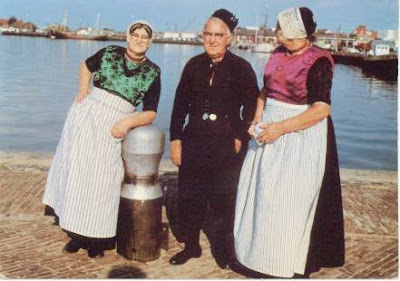
In Walcheren, it is also tucked away in the short sleeved jacket but with lots of folds and more visible because of the more open form of the jacket.


The kraplap of Bunschoten-Spakenburg is the most striking one; it's made of a handpainted cotton and fully stiffened, which makes it look like a giant collar; the red checkered vertical stripe in the middle, is the shawl folded into a strip only in such a way that the kraplap is fully visible.


In Staphorst it is often made from a black woollen muslin with flowers or from black satin handpainted with "stipwerk"; a special painting technique only used in the Staphorster costume. The flowers and stipwerk is dark coloured when the wearer is in mourning (blue and purple on black), otherwise the colours are pretty bright (red, green, yellow etc.). The checkered shawl is covering quite a part of this stunning piece. Which is very much the same situation on the Veluwe, where the kraplappen are not so very brightly patterned.


In Arnemuiden and on Zuid-Beveland the kraplappen are very similar, and also very much covered by the shawl. Often the shawl is made of the same fabric as the kraplap.


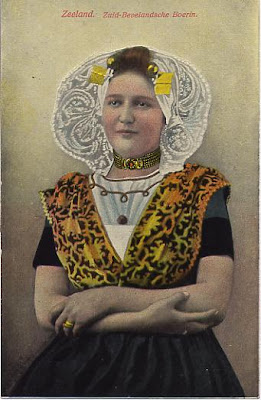

The most decorated kraplap is the one of Axel; it's ingeniously embroidered with glass beads and sequins leaving almost no space of the fabric to be seen. The scarf, which is folded and stuffed like a pair of wings, is covering the fabric, leaving the embroidered part visible as one big front jewel.


I hope you enjoyed this little tour through some of the traditional costumes in The Netherlands. All the pictures are postcards in my possession.
 1. Staphorst in Utrecht Veemarkthallen (11125), 2. 200 year Staphorst, 3. DSC_0019, 4. costum albastru


 Most of the new creations are now in my Etsy shop: P8 Button Art, but there is more to come !


