Today we move from the south-east province of Limburg further north to the east of The Netherlands, the provinces of Gelderland and Overijssel. This part of the Netherlands is the Saxon part, where the people speak low Dutch Saxon and the traditional costumes are very similar. There are differences between the various regions (Achterhoek, Twente, Veluwe, etc.) in this area, but they are very difficult to see for outsiders. That's why I combine them here in the mosaic. The costume itself was an oldfashioned dark, mostly black, city dress. The cap for Sundays, holidays and special occasions was made from beautiful types of lace with a long tail at the back; it was called the "knipmuts". A poorer fashion of this cap was the same model but then crochetted. During weekdays smaller white caps in various forms were worn, but the most frequently seen one is the "plooimuts". The Dutch word "plooi" means "pleat", and this cap has a great number of beautiful large pleats all around.
For more flickr favourites see ArtMind's blog.
 1. The lady who makes those beautiful bonnets - Oud Lunterse Dag - Village festival Lunteren, 2. People of The Netherlands , about half a century ago ..., 3. Traditional Dutch Costume Nr 2, 4. DSC05570 Volksdansen 18-04-2009
And two picture postcards from my own collection.


 This Friday again some non-Dutch stamps with Dutch costumes :)) We start with a cute Dutch boy from the Netherlands Antilles, published in 2008. The costume of the boy must represent the man's costume of Volendam. The Netherlands Antilles was an autonomous country within the Kingdom of the Netherlands, consisting of six islands in the Caribbean Sea. Aruba became a separate country within the Kingdom of the Netherlands in 1986, followed in 2010 by Curaçao and Sint Maarten. Saba, Sint Eustatius and Bonaire joined the Netherlands as "special municipalities". The name "Netherlands Antilles" is still sometimes used to indicate these last three islands.
 The next stamp is from Suriname and shows a Dutch woman in the costume of Volendam waving to a Surinamese woman in the Creole costume called koto missie. This stamp was published to commemorate the first KLM flight between Paramaribo and Amsterdam in May 1949.
 This third stamp is from 1965 and published by the former German Democratic Republic and shows a statue of a Dutch woman of Putten in the traditional costume of the Veluwe. It is a World War II Memorial to commemorate the victims of the German raid on the 1st of October 1944, in which the entire male working population (between 15 and 50 years of age) of Putten was deported to several concentration camps, as a revenge act against a Dutch resistance attack on a German Wehrmacht vehicle nearby on the 30th of September. From the 660 deported men, only 107 men survived the war.
 This fourth stamp is a very fancy one; it's from Umm Al Qiwain (one of the United Arab Emirates) and part of a 1972 series of dolls in traditional costumes of the world. It shows a doll in the costume of Volendam and it is a hologram.
 This last stamp sheet seems to be from Mordovia or Mordvinia, a federal republic of Russia. However, these are forged stamps issued by anonymous private companies operating outside Russia. Among other typical Dutch things, it shows a Dutch woman in the costume of Walcheren in Zeeland and a pair of typical Dutch wooden shoes.
Today in the Flickr Favourites it's the turn of the traditional costume of the North-West Veluwe in The Netherlands. The North-West Veluwe is an area in the north-west of the province of Gelderland along the former Dutch Zuiderzee (but now it lies inland, because of land reclamation). If you have followed this traditional costume series on my blog, you will have noticed that all places and islands around and in the Zuiderzee had their own distinctive costumes. The original North-West Veluwe costume contains an ear ornament usually made of precious metal (locally called ‘oorijzer’, lit. ‘ear-iron’) and a colorful small cap with red flowers and lace. The female attire going with it, was mainly dark in color but with a red checkered scarf crossed over the kraplap (i.e. bodice). From the beginning of 20th century the old traditional costume was gradually replaced by the costume of the North-East of the Veluwe, because lots of the girls from the North-West Veluwe started working in the houses in the cities of the North-East Veluwe (like Kampen). The last woman who was wearing the old costume of the North-West Veluwe was Wijmpje Frens-Wouters, who died at the age of 102 in 2007.
For more flickr favourites see ArtMind's blog.

1. People of The Netherlands , about half a century ago - 'er zijn verschillende manieren om oud te worden , dit is er ook een van ...', 2. Eibertje, 3. Klederdracht, 4. Op en top Holland
And two picture postcards from my own collection.


 After making my bodice / kraplap for the traditional costume challenge from the European Street Team on Etsy, I thought it would be interesting to show you some pictures of bodices / kraplappen from traditional costumes in The Netherlands. Originally the kraplap was a part of the underwear, but in many parts of The Netherlands it has developed into an important decorative part of the outerwear; often very visible and showy, but also sometimes hidden under shawls only revealing a small part under the chin.

In Marken it is worn above all other clothing parts and made from antique pieces of the most beautiful chintz (calico cloth printed with flowers and other devices in different colors).


In Urk the kraplap is more voluminous, mostly made from satin and often embroidered with flowers.
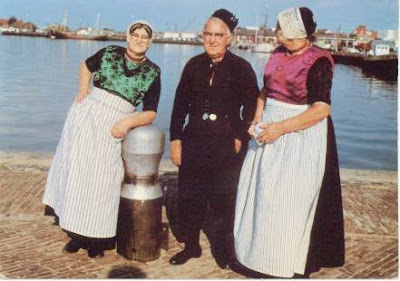

The best known kraplap is the one from Volendam, tucked under the typical short sleeve jacket, often with the most beautiful flower embroidery.


In Walcheren, it is also tucked away in the short sleeved jacket but with lots of folds and more visible because of the more open form of the jacket.


The kraplap of Bunschoten-Spakenburg is the most striking one; it's made of a handpainted cotton and fully stiffened, which makes it look like a giant collar; the red checkered vertical stripe in the middle, is the shawl folded into a strip only in such a way that the kraplap is fully visible.


In Staphorst it is often made from a black woollen muslin with flowers or from black satin handpainted with "stipwerk"; a special painting technique only used in the Staphorster costume. The flowers and stipwerk is dark coloured when the wearer is in mourning (blue and purple on black), otherwise the colours are pretty bright (red, green, yellow etc.). The checkered shawl is covering quite a part of this stunning piece. Which is very much the same situation on the Veluwe, where the kraplappen are not so very brightly patterned.


In Arnemuiden and on Zuid-Beveland the kraplappen are very similar, and also very much covered by the shawl. Often the shawl is made of the same fabric as the kraplap.


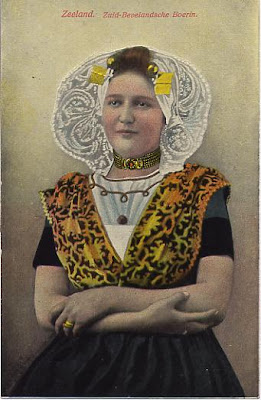

The most decorated kraplap is the one of Axel; it's ingeniously embroidered with glass beads and sequins leaving almost no space of the fabric to be seen. The scarf, which is folded and stuffed like a pair of wings, is covering the fabric, leaving the embroidered part visible as one big front jewel.


I hope you enjoyed this little tour through some of the traditional costumes in The Netherlands. All the pictures are postcards in my possession.
 1. The lady who makes those beautiful bonnets - Oud Lunterse Dag - Village festival Lunteren, 2. People of The Netherlands , about half a century ago ..., 3. Traditional Dutch Costume Nr 2, 4. DSC05570 Volksdansen 18-04-2009


