
This Friday I show you the children charity stamps of The Netherlands of 1960.


Children charity stamps are distributed each year by the Dutch Post and you can buy them at every post office in The Netherlands. There is an extra charge on the stamps, which is intended for cultural, social or health projects. In 1960, the children stamps were designed by Jeanna Bieruma Oosting, one of the most prominent Dutch graphic artists in that time. The rather realistic colored line drawings of children in traditional costumes are placed in front of loudly colored backgrounds. Funny enough, just like the rejected designs of Hubert Levigne from only two years before, she gives only a bust view of the kids (face and half-face).

The stamps depict some traditional costumes from around the former inland sea the Zuiderzee (now Lake IJsselmeer), and very appropriately the first sale of these stamps started in the Zuiderzee Museum in Enkhuizen. The children portrayed are Aaltje van Rie from Marken (4 ct), Jannetje Kwakman from Volendam (6 ct), Magda van Halteren from Bunschoten (8 ct), Janna Marijke Atema from Hindeloopen (12 ct) and Dittie Klein from Huizen (30 ct).

I think this 1960 series is a very charming set, lovely designs with children very well taken into consideration.
 After making my bodice / kraplap for the traditional costume challenge from the European Street Team on Etsy, I thought it would be interesting to show you some pictures of bodices / kraplappen from traditional costumes in The Netherlands. Originally the kraplap was a part of the underwear, but in many parts of The Netherlands it has developed into an important decorative part of the outerwear; often very visible and showy, but also sometimes hidden under shawls only revealing a small part under the chin.

In Marken it is worn above all other clothing parts and made from antique pieces of the most beautiful chintz (calico cloth printed with flowers and other devices in different colors).


In Urk the kraplap is more voluminous, mostly made from satin and often embroidered with flowers.
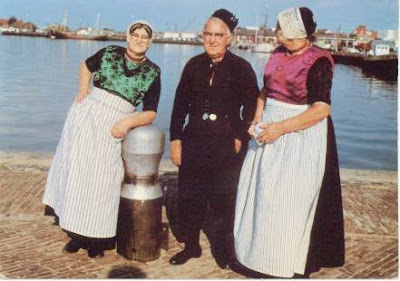

The best known kraplap is the one from Volendam, tucked under the typical short sleeve jacket, often with the most beautiful flower embroidery.


In Walcheren, it is also tucked away in the short sleeved jacket but with lots of folds and more visible because of the more open form of the jacket.


The kraplap of Bunschoten-Spakenburg is the most striking one; it's made of a handpainted cotton and fully stiffened, which makes it look like a giant collar; the red checkered vertical stripe in the middle, is the shawl folded into a strip only in such a way that the kraplap is fully visible.


In Staphorst it is often made from a black woollen muslin with flowers or from black satin handpainted with "stipwerk"; a special painting technique only used in the Staphorster costume. The flowers and stipwerk is dark coloured when the wearer is in mourning (blue and purple on black), otherwise the colours are pretty bright (red, green, yellow etc.). The checkered shawl is covering quite a part of this stunning piece. Which is very much the same situation on the Veluwe, where the kraplappen are not so very brightly patterned.


In Arnemuiden and on Zuid-Beveland the kraplappen are very similar, and also very much covered by the shawl. Often the shawl is made of the same fabric as the kraplap.


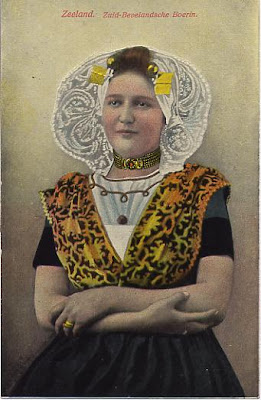

The most decorated kraplap is the one of Axel; it's ingeniously embroidered with glass beads and sequins leaving almost no space of the fabric to be seen. The scarf, which is folded and stuffed like a pair of wings, is covering the fabric, leaving the embroidered part visible as one big front jewel.


I hope you enjoyed this little tour through some of the traditional costumes in The Netherlands. All the pictures are postcards in my possession.


