 After the Basque costume stamps of Spain, we move even further northwest to La Rioja, Cantabria and Asturias. The typical costumes from these regions look in style like the ones we have seen in Catalonia, Aragon, Navarra and the Basque Country. They belong to the typical "northern" clothing category: costumes are inspired by a peasant way of life, with rather simple colors, to which elements such as characteristic shoes are added, fluffy petticoats, lace and stockings. The first stamp above is from a very large costume series issued from 1967 to 1971. The costume is typical for the city of Logroño in Rioja.
 This next stamps is from the same large costume series (1967 to 1971) and shows the traditional costume of the city of Santander in Cantabria.
 And from the same series, the regional costume of Oviedo in Asturias.
You can find La Rioja (light tan), Cantabria (dark tan) and Asturias (beige) on this map of Spain (in the north):

Today we move south from West Friesland to the Zaan district, staying within the province of North-Holland. This was a very rich area, and you can see that clearly in the traditional costumes. The dress was 6 meters wide and made of silk damask. The headdress existed of a black under cap, a white intermediate cap with embroidery, an upper cap of batiste with broad lace and a golden head-iron of 7 cm width with a large number of golden needles, sometimes decorated with diamonds. To protect this expensive headdress if you went outside, the "Zaanse kaper" was put on top of it. This broad over cap, mostly made of shot silk (dark outside, light inside), was stiffened by whale bones and cardboard. The lower part formed a small cape around the shoulders.
For more flickr favourites see ArtMind's blog.

1. april, 2. Doopsgezinden gemeenschap 29, 3. Optocht, 4. 306356
And two picture postcards from my own collection.


Today we move from the north of The Netherlands back to the west of The Netherlands, so we have almost made the total round tour of The Netherlands. We are back in the province of North-Holland, and look at the area which is called West Friesland. The costumes are similar to the ones in Friesland, but the lace cap and the head-iron are different. The women wear a rich costume (silk, wool, damask) and lots of jewelry. The lace cap has a small pleated and starched tail, and the head iron is partly visible.
For more flickr favourites see ArtMind's blog.
 1. People of The Netherlands , about half a century ago ..., 2. Hand in hand, 3. part of a costume., 4. Nederland / The Netherlands
And two picture postcards from my own collection.


 After the costume stamps of Aragon, we move now furher to the west to Navarre and Basque Country. Both Navarre and the Basque Country are autonomous communities in northern Spain. Basque is spoken in large parts of Navarre and in all three provinces of Basque Country: Álava, Biscay and Gipuzkoa. The traditional costume for the men is made up of a red sash and scarf (a pañuelico or pañuelo), worn with a pair of white pants and white shirt. Red was adopted as the official color because it is a festive color, but blue, green, black or checkered also exist. The white pants and shirt are adaptations of the simple, traditional clothing worn by farm workers and other laborers and is also adopted by pelota players in Navarra and the Basque country. The sash was the belt; the pañuelo was worn around the neck and used to wipe away the sweat of a hard days work. The shoes are espadrilles and the cap is the traditional Basque béret (boina) in either black or red. The women wear a red skirt, black petticoat, white blouse, white headscarf, black apron and on their feet laced leather sandals with woolen socks, or white espadrilles decorated with red ribbons. Only in some valleys of Navarre, there still exist some very different traditional costumes, more like the ones of Huesca in neighboring Aragon. The first stamp above shows such a beautiful antique costume of Valle del Roncal in Navarre. It is from a very large costume series issued from 1967 to 1971. All other stamps show the more usual red and white Basque costumes. The second stamp above celebrates the "running of the bulls" at the San Fermin Festival in Pamplona, the capital city of Navarre.

 The next two stamps show the costumes of Álava and Gipuzkoa. Both stamps are again from the large costume series of 1967-1971.


The next two stamps show the costumes of Biscay. The first one is again from the large costume series of 1967-1971. The second one is from a series of Spanish Zarzuela's issued in 1983, with a scene from "El Caserio" from Basque composer Jesús Guridi Bidaola.
You can find Navarre (grey) and the Basque Country (purples) on this map of Spain (in the north):

 After the Catalan costume stamps of Spain, we move now from Catalonia to the west to Aragon. Aragon is an autonomous community in Spain, once the medieval kingdom of Aragon. Located in northeastern Spain, the region comprises three provinces from north to south: Huesca, Zaragoza, and Teruel. Aragon's northern province of Huesca borders France and is positioned in the middle of the Pyrenees. Within Spain, the region is flanked by Catalonia on the east, Valencia and Castile-La Mancha to the south, and Castile and León, La Rioja, and Navarre to the west. In north Aragon, the costumes have still very old elements, and is a bit similar to the costumes in neighboring Navarre. Most striking are the (mostly green colored) long skirt and the pleated linen puffy sleeves and high neck cuff. In the other parts of Aragon, the costumes have similarities with the Catalan costumes.
The stamps above show the beautiful antique costumes of Huesca in north Aragon. The first one is from a very large costume series issued from 1967 to 1971. The second stamp is from the "Popular Festivals" series, issued in 2003, for the the Day of the Costume Festival in Ansó.

 The next two stamps show the costume of Zaragoza. The first one is again from the large costume series of 1967-1971, and the second one is from a series of Spanish Zarzuela's issued in 1982, with a scene from "Gigantes y Cabezudos" from Spanish composer Manuel Fernandez Caballero.

 The next stamp shows the costume of Teruel, and is again from the large costume series of 1967-1971. The last stamp is of the yearly Europa Stamp series, which was about "Folklore and Feasts" in 1981, and shows people dancing the jota, a fast traditional dance from Aragon.
You can find Aragon on this map of Spain (the olive green areas in the north east of Spain):
Today we move from the east of The Netherlands to the north of The Netherlands, the provinces of Friesland, Groningen and Drenthe. There are differences in the costumes between the various regions in this area, but they are very difficult to see for outsiders. That's why I combine them here in the mosaic. The women wear a rich costume (silk, wool, damask) with the characteristics of the crinoline fashion, namely a tailored upper part with a wide skirt and petticoats. Above it they wear a scarf and an apron made of embroidered lace. The most striking element however is the the broad gold casque, a goldcap that covers the entire head. Above the gold casque they wear a lace cap with a small pleated tail.
For more flickr favourites see ArtMind's blog.
 1. People of The Netherlands , about half a century ago, 2. Lace headdress, 3. Ljouwerter Skotsploech-Folklore Dancing-Group, 4. Ringstekken Burgum
And two picture postcards from my own collection.


After the Catalan costume stamps from France and Andorra in the last weeks, we look this week at the Catalan costumes on stamps from Spain. Catalonia is one of the seventeen autonomous communities of the Kingdom of Spain. It comprises four provinces: Barcelona, Girona, Lleida and Tarragona, and borders France and Andorra to the north, Aragon to the west, the Valencian Community to the south, and the Mediterranean Sea to the east.
The stamps above are from a very large costume series issued from 1967 to 1971. They show the Catalan costumes from Barcelona, Girona, Lleida and Tarragona, respectively.

The next stamp is from 1977 (series of Spanish celebrities) and shows the Catalan poet Jacinto Verdaguer (1845-1902) in the barretina (traditional Catalan hat).
You can find Catalonia on this map of Spain (the pink areas in the north east of Spain):


We stay this week in Andorra, but this time we look at the Spanish postage stamps. Andorra, officially the Principality of Andorra, is a small landlocked country in southwestern Europe, located in the eastern Pyrenees mountains and bordered by Spain and France. The Principality was formed in 1278. The role of monarch is exercised jointly by the two co-princes, the President of the French Republic and the Bishop of Urgell, Catalan Countries. Therefore, Andorra has French and Spanish stamps, issued by France and Spain, respectively.
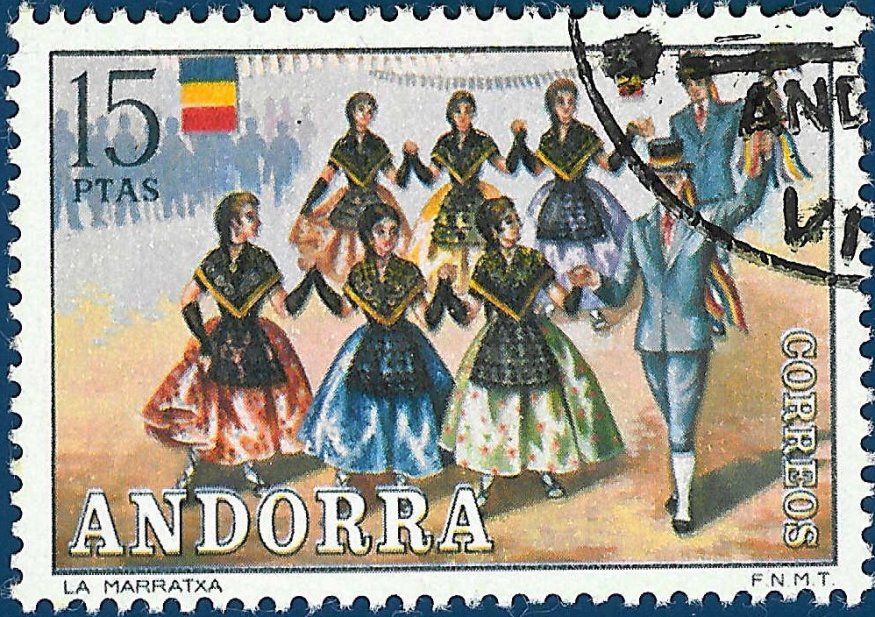
The Andorran costume is very similar to the Catalan costumes worn in France and Spain. For women the costume features a full, mostly flowered skirt over a white petticoat; a blouse (sometimes covered by a flowered shawl); long, black, fingerless net gloves; and black espadrilles (cloth sandals) with white stockings. The traditional costume for men is a white shirt, dark knee-length pants, white stockings, black shoes, broad red sashes tied at the waist and the barretina (the traditional Catalan cap).
The stamps above are from a series of 1972 celebrating Andorran customs. They show "Les Caramelles" (traditional Easter songs choir) and La Marratxa (a traditional dance representing the two co-princes dancing with the six parishes), respectively.

 The next two stamps are from 1975 ("Espana 75" International Stamp Exhibition in Madrid) and 1978 (50th Anniversary of Spanish Post Office), respectively. They both show postmen delivering post at ladies in traditional costumes.


 These last pictures show a series of 3 stamps with traditional costumes from 1979 (a you woman, a young man and newly-weds) and 1 stamp of the yearly Europa Stamp series, which was about "Folklore and Feasts" in 1981, showing people dancing the Santa Anna dance.
You can find Andorra on this map of France:
Today we move from the province of North Brabant to the south east to the neighboring province of Limburg. The famous "poffer" from North-Brabant is called "toer" in Limburg, and was worn in the north of that province. The other costume shown in the mosaic is from the south of the province, mostly around the city of Stein. This costume was more colorful and had a less elaborate headdress; a small white cotton bonnet, with a black crochet bonnet on top or a kerchief, the "kopplak". The shawl has a colored border and the apron came in various colors.
For more flickr favourites see ArtMind's blog.
 1. Nationaal Tinnen Figuren Museum 2010, 2. World Folklore Festival Brunssum 2008, Netherlands, 62, 3. World Folklore Festival Brunssum 2008, Netherlands, 65, 4. limburg
And two picture postcards from my own collection.


 After the Basque costume stamps of Spain, we move even further northwest to La Rioja, Cantabria and Asturias. The typical costumes from these regions look in style like the ones we have seen in Catalonia, Aragon, Navarra and the Basque Country. They belong to the typical "northern" clothing category: costumes are inspired by a peasant way of life, with rather simple colors, to which elements such as characteristic shoes are added, fluffy petticoats, lace and stockings. The first stamp above is from a very large costume series issued from 1967 to 1971. The costume is typical for the city of Logroño in Rioja.
  This next stamps is from the same large costume series (1967 to 1971) and shows the traditional costume of the city of Santander in Cantabria.
 And from the same series, the regional costume of Oviedo in Asturias.


 1. People of The Netherlands , about half a century ago ..., 2. Hand in hand, 3. part of a costume., 4. Nederland / The Netherlands


 1. People of The Netherlands , about half a century ago, 2. Lace headdress, 3. Ljouwerter Skotsploech-Folklore Dancing-Group, 4. Ringstekken Burgum




 1. Nationaal Tinnen Figuren Museum 2010, 2. World Folklore Festival Brunssum 2008, Netherlands, 62, 3. World Folklore Festival Brunssum 2008, Netherlands, 65, 4. limburg


 1. It's All In The Details, 2. Back in time, 3. 1932 - Kerkhof stoet Odafeesten (colorized) Sint Oedenrode, 4. mobilisatie 1916


