Today we move from the north of The Netherlands back to the west of The Netherlands, so we have almost made the total round tour of The Netherlands. We are back in the province of North-Holland, and look at the area which is called West Friesland. The costumes are similar to the ones in Friesland, but the lace cap and the head-iron are different. The women wear a rich costume (silk, wool, damask) and lots of jewelry. The lace cap has a small pleated and starched tail, and the head iron is partly visible.
For more flickr favourites see ArtMind's blog.
 1. People of The Netherlands , about half a century ago ..., 2. Hand in hand, 3. part of a costume., 4. Nederland / The Netherlands
And two picture postcards from my own collection.


Today we move from the south-east province of Limburg further north to the east of The Netherlands, the provinces of Gelderland and Overijssel. This part of the Netherlands is the Saxon part, where the people speak low Dutch Saxon and the traditional costumes are very similar. There are differences between the various regions (Achterhoek, Twente, Veluwe, etc.) in this area, but they are very difficult to see for outsiders. That's why I combine them here in the mosaic. The costume itself was an oldfashioned dark, mostly black, city dress. The cap for Sundays, holidays and special occasions was made from beautiful types of lace with a long tail at the back; it was called the "knipmuts". A poorer fashion of this cap was the same model but then crochetted. During weekdays smaller white caps in various forms were worn, but the most frequently seen one is the "plooimuts". The Dutch word "plooi" means "pleat", and this cap has a great number of beautiful large pleats all around.
For more flickr favourites see ArtMind's blog.
 1. The lady who makes those beautiful bonnets - Oud Lunterse Dag - Village festival Lunteren, 2. People of The Netherlands , about half a century ago ..., 3. Traditional Dutch Costume Nr 2, 4. DSC05570 Volksdansen 18-04-2009
And two picture postcards from my own collection.


Today in the Flickr Favourites it's the turn of the traditional costume of the North-West Veluwe in The Netherlands. The North-West Veluwe is an area in the north-west of the province of Gelderland along the former Dutch Zuiderzee (but now it lies inland, because of land reclamation). If you have followed this traditional costume series on my blog, you will have noticed that all places and islands around and in the Zuiderzee had their own distinctive costumes. The original North-West Veluwe costume contains an ear ornament usually made of precious metal (locally called ‘oorijzer’, lit. ‘ear-iron’) and a colorful small cap with red flowers and lace. The female attire going with it, was mainly dark in color but with a red checkered scarf crossed over the kraplap (i.e. bodice). From the beginning of 20th century the old traditional costume was gradually replaced by the costume of the North-East of the Veluwe, because lots of the girls from the North-West Veluwe started working in the houses in the cities of the North-East Veluwe (like Kampen). The last woman who was wearing the old costume of the North-West Veluwe was Wijmpje Frens-Wouters, who died at the age of 102 in 2007.
For more flickr favourites see ArtMind's blog.

1. People of The Netherlands , about half a century ago - 'er zijn verschillende manieren om oud te worden , dit is er ook een van ...', 2. Eibertje, 3. Klederdracht, 4. Op en top Holland
And two picture postcards from my own collection.


Today in the Flickr Favourites it's the turn of the traditional costume of Schokland in The Netherlands. Schokland was an island in the former Dutch Zuiderzee. As a result from the increasing sea-level Schokland transformed from an attractive settlement area in the Middle Ages to a place under continuous threat by floods in the 19th century. By that time the Schoklanders had retreated to the three most elevated parts, Emmeloord, Molenbuurt, and Middelbuurt. A major flood in 1825 brought massive destruction, and in 1859 the government decided to end permanent settlement on Schokland. The population of Schokland was moved to Kampen on the mainland. Schokland lost its status as an island when the Noordoostpolder was reclaimed from the sea in 1942. The remains are still visible as a slightly elevated part in the polder and by the still partly intact retaining wall of the waterfront of Middelbuurt.
Just as other islands in the Zuider Zee, Schokland had its own distinctive costume. The original Schokland costume very much resembled that of the island of Marken. A characteristic feature was the cylindrical bonnet with loose chin ribbons and the colorful outer garments. In the course of time changes appeared, likely influenced by the proximity of the island of Urk. By the end of the 18th century a costume with an ear ornament usually made of precious metal (locally called ‘oorijzer’, lit. ‘ear-iron’) and a starched white bonnet were quite popular with the women on Schokland. The female attire going with it, was mainly dark blue or black in color and made a less pretentious impression. A necklace of red coral beads indicated the wearer’s wealth and standing. Many of the elders held on to the traditional costume, so that both variants persisted over time. After the evacuation the population spread over the mainland surrounding the Zuider Zee, the traditional costume became obsolete and it was lost at the beginning of the last century. There is a choir existing of offspring from the former island who sing in costume.
For more flickr favourites see ArtMind's blog.

1. WL-090506-033, 2. bloedkoralen, 3. Schokkerkoor op Schokland, 4. www.flickr.com/photos/jackvandongen/4990415866/in/gallery...
And two picture postcards from my own collection.


 After making my bodice / kraplap for the traditional costume challenge from the European Street Team on Etsy, I thought it would be interesting to show you some pictures of bodices / kraplappen from traditional costumes in The Netherlands. Originally the kraplap was a part of the underwear, but in many parts of The Netherlands it has developed into an important decorative part of the outerwear; often very visible and showy, but also sometimes hidden under shawls only revealing a small part under the chin.

In Marken it is worn above all other clothing parts and made from antique pieces of the most beautiful chintz (calico cloth printed with flowers and other devices in different colors).


In Urk the kraplap is more voluminous, mostly made from satin and often embroidered with flowers.

The best known kraplap is the one from Volendam, tucked under the typical short sleeve jacket, often with the most beautiful flower embroidery.


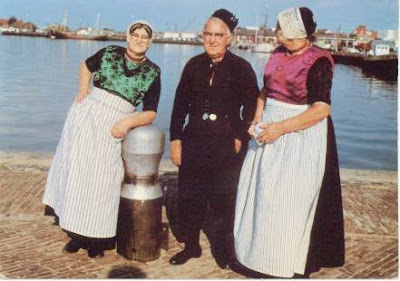
In Walcheren, it is also tucked away in the short sleeved jacket but with lots of folds and more visible because of the more open form of the jacket.


The kraplap of Bunschoten-Spakenburg is the most striking one; it's made of a handpainted cotton and fully stiffened, which makes it look like a giant collar; the red checkered vertical stripe in the middle, is the shawl folded into a strip only in such a way that the kraplap is fully visible.


In Staphorst it is often made from a black woollen muslin with flowers or from black satin handpainted with "stipwerk"; a special painting technique only used in the Staphorster costume. The flowers and stipwerk is dark coloured when the wearer is in mourning (blue and purple on black), otherwise the colours are pretty bright (red, green, yellow etc.). The checkered shawl is covering quite a part of this stunning piece. Which is very much the same situation on the Veluwe, where the kraplappen are not so very brightly patterned.


In Arnemuiden and on Zuid-Beveland the kraplappen are very similar, and also very much covered by the shawl. Often the shawl is made of the same fabric as the kraplap.


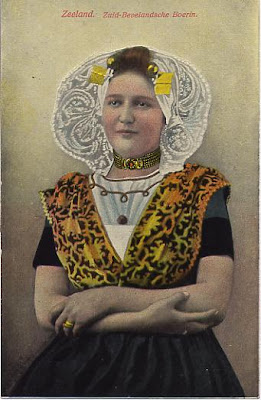

The most decorated kraplap is the one of Axel; it's ingeniously embroidered with glass beads and sequins leaving almost no space of the fabric to be seen. The scarf, which is folded and stuffed like a pair of wings, is covering the fabric, leaving the embroidered part visible as one big front jewel.


I hope you enjoyed this little tour through some of the traditional costumes in The Netherlands. All the pictures are postcards in my possession.
 1. People of The Netherlands , about half a century ago ..., 2. Hand in hand, 3. part of a costume., 4. Nederland / The Netherlands

 1. The lady who makes those beautiful bonnets - Oud Lunterse Dag - Village festival Lunteren, 2. People of The Netherlands , about half a century ago ..., 3. Traditional Dutch Costume Nr 2, 4. DSC05570 Volksdansen 18-04-2009


 1. Staphorst in Utrecht Veemarkthallen (11125), 2. 200 year Staphorst, 3. DSC_0019, 4. costum albastru


