This week some lovely postage stamps with the "Santons" of the Provence. Santons are clay figurines that depict the colorful people, traditional trades, traditional activities and traditional 19th century costumes of the Provence. Santon comes from the Provencal "santoùon", or little saint. Jean-Louis Lagnel (1764-1822) of Marseilles, who made molded figurines for church crèches, decided during the French Revolution, to make the santons for the general population, at a price they could afford. Santons for the public became an instant success, and an industry and tradition was born. Next to the typical Nativity scene Santons like the three wise kings, the shepherds, Joseph, Mary and the baby Jesus, the Provencal crèches depict typical Provencal village inhabitants, like the fishmonger, the lavender woman, the lumberjack, etc. The two stamps above are from the 1995 Red Cross series of France; they show the fishwife and the elderly couple.


 The next three stamps are from the 1984 Christmas series of Monaco; they show the spinning woman, the garlic woman and the couple "Grasset and Grassette" (stands for kind people, nice and devoted grandparents).
 And this last stamp is from the 1991 Christmas series of Monaco; it shows the Arlésienne. She is a native of the city of Arles. Young and pretty, she is always dressed in the very refined traditional costume of the region of Arles.
You can find the Provence on this map:
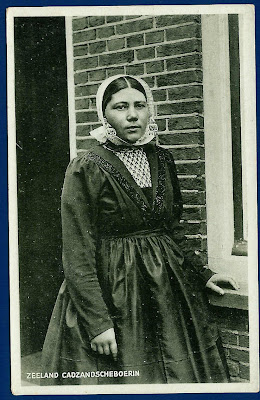
Today we move further along the North Sea coast to the most southern western part of The Netherlands till we reach the town of Cadzand in the region of Zeeuws-Vlaanderen in the province of Zeeland. In the 17th and 18th centuries some French Huguenots fled to Cadzand, which is still "visible" nowadays in the large number of French family names in Zeeuws-Vlaanderen. The costume looks very sober; it is a fashion costume from around 1880, mostly in black, dark blue, dark brown or dark green. The small cap is much older; it is made of lace from Mechelen in Belgium and a small carcass to stiffen it, and is worn over a simple black under cap. It has no head iron, so no place for showing off your wealth in gold or silver, and it is tight to the face, so that there was no place for earrings too. That's why they wear the so-called golden cap-rings hooked into the black under cap :)
For more flickr favourites see ArtMind's blog.
 1. folkloristishdag ijzendijke18072009 DSC_0215 crop 2, 2. Molens en Klederdrachten in Nederland 20, 3. folkloristishdag ijzendijke18072009 DSC_0054, 4. DSC_0007 crop
And two picture postcards from my own collection.

It is Wednesday again, so it's BUTTON DAY on my blog !!!!!!!!!!!!!!!!!
 This Button Wednesday is about the fabulous button dress, Xiaopei "Jennifer" Wu made for the International Surface Design Association's Student Exhibition in Kansas City (2009), where she won the top design prize. Wu studied at the Fiber Science & Apparel Design program of Cornell University. Wu's "Button Dress" features an asymmetrical seamed bodice made from silk charmeuse and embellished with hand-sewn silk chiffon, buttons, beads and gems. On the skirt are 2000 shell buttons sewn on by hand. Wu spent more than 300 hours creating the dress.
 "I wanted to make a piece, not to 'wow,' but to beckon the audience to come closer and look," said Wu. "I am about detail." She was inspired by the painting "The Birth of Venus" by Sandro Botticelli, which depicts the goddess Venus emerging from the sea as a woman.

Have you seen a lovely, beautiful, stunning, crazy button or button-related thingy, or did you make something with a button / buttons, or did you even make buttons yourself, blog about it on your blog on Wednesday, and give the link here in the comments so that everybody can enjoy it !!


 And this last stamp is from the 1991 Christmas series of Monaco; it shows the Arlésienne. She is a native of the city of Arles. Young and pretty, she is always dressed in the very refined traditional costume of the region of Arles.